Roberto Fabelo, born José Roberto Fabelo Pérez on January 28, 1950, in Guáimaro, Camagüey, Cuba, exhibited an early passion for drawing dubbed "graphomania," sketching imaginative scenes on scraps of paper that foreshadowed his career in visual arts. He pursued formal education at the National School of Art (ENA) from 1967 to 1972 and graduated from the Instituto Superior de Arte (ISA) in Havana in 1981, where he later taught, immersing himself in painting, sculpture, drawing, engraving, and illustration while engaging with Cuba's cultural institutions like the Union of Writers and Artists of Cuba (UNEAC) and the International Union of Visual Artists (AIAP).
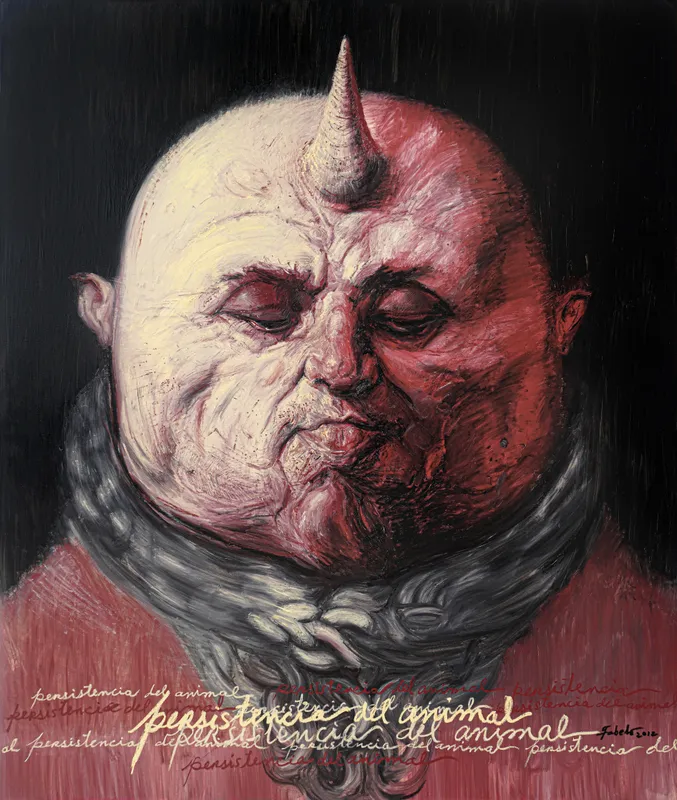
Emerging in the 1980s as part of "the generation of sure hope" alongside artists like José Bedia, Fabelo gained recognition during the inaugural Havana Biennial, where he won the Armando Reverón International Drawing Prize. His artistic style fuses surrealism, caricature, and symbolism, creating bizarre, dreamlike compositions that merge vibrant colors, intricate details, and fantastical elements—anthropomorphic animals, hybrid creatures, nude figures, and everyday objects—to probe themes of identity, the human condition, societal hypocrisy, and the interplay between humanity and nature. Influences from Francisco de Goya's satirical engravings, Hieronymus Bosch's grotesque visions, Honoré Daumier's caricatures, Gabriel García Márquez's magical realism, and the technical precision of Dutch and Flemish masters like Rembrandt inform his work, often likened to Dante's Divine Comedy for its allegorical depth.
Key series and works include Sobrevivientes (Survivors), featuring life-sized rhinoceros sculptures symbolizing environmental fragility and giant cockroaches with human faces tributing Franz Kafka's The Metamorphosis; Viaje Fantástico, a monumental public sculpture in Havana's Plaza Vieja depicting a nude woman riding a rooster armed with a fork; Historia permanente (Permanent History), a large-scale installation exploring enduring narratives; Mundos: Goya y Fabelo, juxtaposing his pieces with Goya's engravings to highlight shared imaginative realms; and illustrations for a special edition of García Márquez's Cien años de soledad (One Hundred Years of Solitude). His watercolors often feature absurdist humor, such as bare-chested women donning tin pots or conch shells as hats, while his sculptures and installations emphasize conservation and cultural commentary.
Fabelo has exhibited extensively in Cuba and abroad, with solo and group shows in venues across Spain, Italy, Chile, France, Denmark, Sweden, Germany, Panama, Mexico, Venezuela, England, the United States, and China, including the Museum of Latin American Art in California, the Palace of the Vatican Chancellery, Fundación Ibercaja in Madrid, Galleria Degli Uffizi in Florence (housing his self-portrait), International Drawing Biennial in London, and the Kennedy Center in Washington, D.C. Permanent installations grace public spaces like Havana's Plaza Vieja and Zaragoza's Plaza del Pilar, and his works feature in collections at the Museo Nacional de Bellas Artes in Havana, Pérez Art Museum Miami, Galleria Degli Uffizi, Drammens Museum in Norway, Cuban embassy in Mexico, and private holdings auctioned at Christie's, Sotheby's, Phillips de Pury & Company, and Bonhams—notably a triptych The Speech of the Flies fetching high acclaim.
Awards underscoring his contributions include Cuba's National Prize for Plastic Arts, Medal of National Culture, Alejo Carpentier Medal, and La Rosa Blanca Award (twice); UNESCO's Prize for the Promotion of the Fine Arts in Paris; first prize at the Ibero-American Watercolor Biennial in Viña del Mar, Chile; first prize at the International Drawing Biennale in Cleveland, Great Britain; Purchase Prize at the Triennale for Contemporary Art in New Delhi, India; Drawing Prize at Intergraphik in Berlin; and the New Delhi Triennial Prize for Contemporary Art. Beyond creation, Fabelo mentors emerging artists, promotes Cuban heritage, and engages in conservation efforts, establishing him as a pivotal influence in bridging traditional mastery with contemporary innovation in Latin American art.