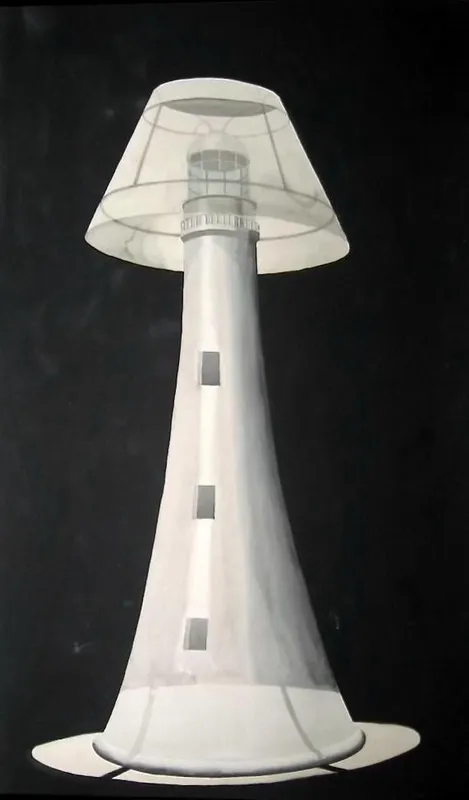
Los Carpinteros originated in 1992 amid the economic hardships of Cuba's Special Period, when three young artists—Marco Antonio Castillo Valdes (born 1971), Dagoberto Rodríguez Sánchez (born 1969), and Alexandre Arrechea (born 1970)—met at Havana's Instituto Superior de Arte and began collaborating under the name to honor the artisan tradition of carpenters, emphasizing collective craftsmanship over individual authorship. Initially a trio, they gained recognition for works that fused sculpture, architecture, and drawing, often fabricating large-scale objects like dysfunctional furniture or imploding edifices that critiqued the utopian promises of modernism while reflecting the ingenuity required in resource-scarce environments. By 1994, they formalized the collective identity, producing pieces such as "Ciudad Transportable" (2000), a collapsible urban model evoking nomadic existence, and "Piscina" (2001), a swimming pool shaped like a military bunker, which underscored tensions between leisure and control in Cuban society.
In 2003, Arrechea left to pursue solo projects, leaving Castillo and Rodríguez to evolve the practice with a sharper focus on global themes of migration and urban transformation. Their installations, like "Retractil" (2007), a retractable brick wall commenting on barriers and borders, or "Conga Irreversible" (2012), a performance inverting traditional Cuban dance into a backward march, incorporate wit to dissect power structures and cultural memory. Drawing from Soviet-era influences in Cuba and broader Latin American conceptual art, they employ materials like wood, brick, and metal to create hybrid forms that appear functional yet reveal inherent flaws upon closer inspection, prompting viewers to question the reliability of built environments.
The collective's international trajectory includes major exhibitions at institutions such as MoMA, the Guggenheim, and the Centre Pompidou, with residencies and commissions spanning Europe, the United States, and Latin America. Their approach remains rooted in collaborative processes, often involving local fabricators, and extends to public interventions that engage communities in rethinking shared spaces. As of the mid-2020s, Castillo and Rodríguez, now based between Havana and Madrid, continue to produce work that navigates the intersections of art, design, and politics, adapting to contemporary issues like climate-induced displacement while maintaining a commitment to materiality and irony that sets them apart from purely conceptual practices.