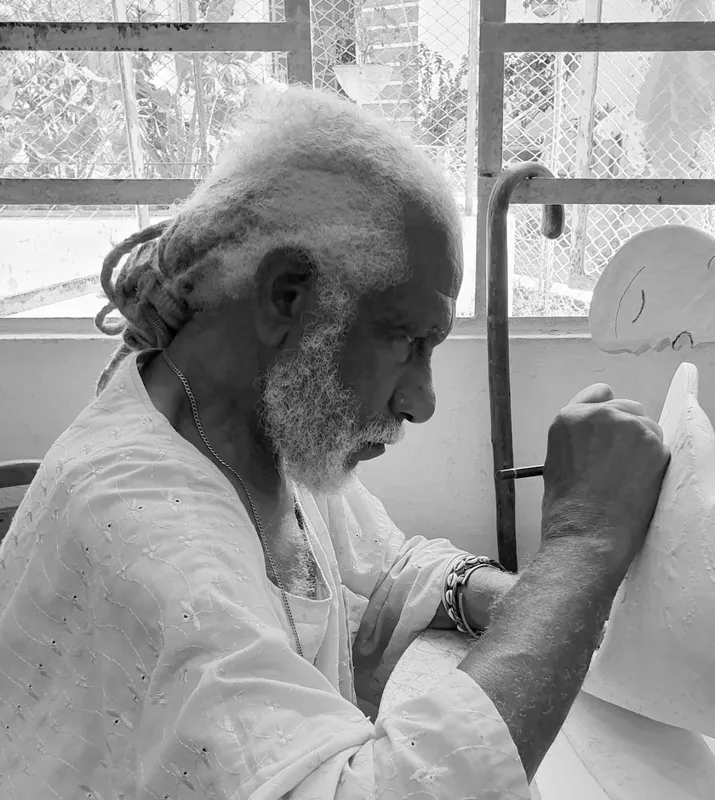
Manuel Mendive was born in 1944 in Havana, Cuba, into a family that practiced Santería, the syncretic faith that fuses Yoruba traditions with Catholic elements and became the spiritual bedrock of his entire creative universe. He graduated from the prestigious San Alejandro Academy of Fine Arts in 1963 with honors in painting and sculpture, yet quickly turned away from the rigid social realism favored at the time, choosing instead to honor the living mythological thought of his Afro-Cuban heritage. Drawing inspiration from the orishas—those powerful mediators between the human and divine—and from the patakis, the sacred stories passed through generations, Mendive forged an aesthetic language that reconciled European technical mastery with the vibrant, symbolic imagery of West African roots, echoing yet expanding the path first opened by Wifredo Lam.
At the core of Mendive’s oeuvre lies a profound celebration of the interconnectedness of nature, spirit, and body. His paintings pulse with luminous color and sinuous line, populating canvases with hybrid figures—humans merging with birds, fish, flowers, and deities—where the erotic and the sacred dance in ecstatic equilibrium. Works such as Oya (1967) and Slave Ship (1976) confront the wounds of the Middle Passage and colonial violence, while later pieces like Viento a Fete (1984) and Olofi, the Spirits, Man and Nature (1997) radiate a luminous joy, portraying the harmonious union of humanity with the universe. Beyond the canvas, Mendive pioneered performance and body art in Cuba, painting dancers’ naked bodies with ritual motifs, designing theatrical backdrops and altars, and creating soft sculptures that turn the gallery into a living temple of Afro-Cuban cosmology. Whether in monumental carvings, delicate drawings, or immersive environments, his art insists that myth is not distant history but a living force that sustains identity, resistance, and renewal.
Mendive’s exhibitions have unfolded across the globe, from the Havana Biennial and the Venice Biennial to major institutions in Europe, Latin America, Africa, and the United States, including the Centre Georges Pompidou, the Bronx Museum of the Arts, and the California African American Museum. His work resides in prominent collections such as the Museo Nacional de Bellas Artes in Havana, the Musée d’Art Moderne in Paris, and numerous museums in Russia, Scandinavia, and beyond. Through a language at once primal and refined, Manuel Mendive maps the invisible currents that bind the ancestral to the present, offering a luminous testament to the enduring power of Afro-Cuban spirituality and the transcendent beauty of a world where every form carries the breath of the divine.