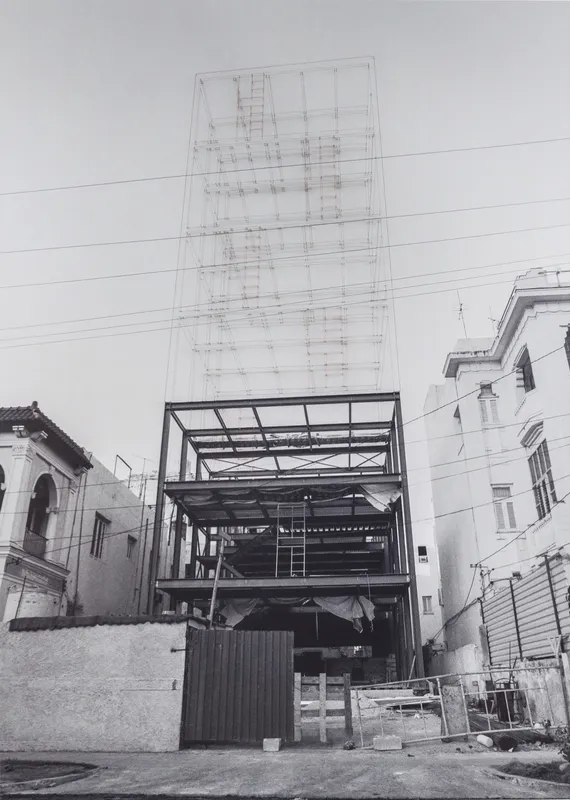
Carlos Garaicoa was born i n 1967 i n Havana's old quarter (Habana Vieja), Cuba. Before pursuing art, he studied thermodynamics and later served in the Cuban military as a draughtsman, experiences that sharpened his interest in structure, systems, and the built environment. H e enrolled a t the Instituto Superior d e Arte (ISA) i n Havana i n 1989, graduating in painting in the early 1990s. Emerging during a period o f profound economic and ideological crisis following the collapse o f the Soviet Union, Garaicoa developed a practice deeply engaged with the archaeology o f the city and the physical and symbolic ruins o f utopian projects.
His work consistently explores the dialogue between art and urban space, using architecture as a lens t o examine how political ideologies shape society and daily life. Through subtle gestures rather than monumental statements, Garaicoa addresses the disintegration o f modernist dreams, the contradictions o f Cuban reality, and broader questions o f power, memory, and public versus private space. Notable series employ neon signs t o complete or critique unfinished buildings, intricate thread drawings overlaying photographs o f Havana's decaying structures, light installations, and architectural models that reimagine o r mourn lost ideals. Works such as those from the late 1990s onward often juxtapose past promises with present conditions, blending irony, poetry, and conceptual rigor.
Garaicoa has exhibited extensively worldwide, participating i n multiple editions of the Havana Biennial, the Venice Biennale, Documenta, the São Paulo Biennial, Johannesburg Biennial, and numerous international institutions including the Museum of Modern Art, Guggenheim Museum, Tate Modern, and Reina Sofia. He has held solo exhibitions at major museums across Europe, Latin America, and the United States. His pieces are held in prominent public and private collections globally.
Through a multidisciplinary approach that moves fluidly between media, Carlos Garaicoa has established himself as one of the most influential contemporary artists from Cuba, offering nuanced reflections on the complex relationship between ideology, the city, and human experience.